Spring break
Kevin the Star StrikerSpring break is the period when the Wild Soccer Bunch expects childhood to become almost pure freedom through soccer, but the book turns that expectation into a conflict with weather, family discipline, poverty, and the Unbeatables. Its promise of two weeks without school is repeatedly frustrated, and its eventual association with the team’s victory makes it less a holiday than the season in which the boys become a team.
Promise of Freedom
Spring break first appears as a countdown to liberation. Only five days separate the boys from two weeks without school or homework, when they imagine running to the soccer field after breakfast and staying until sunset, interrupted only by soccer and lemonade from Larry’s lemonade stand. The fantasy is physical and specific: lemonade will soothe their thirst, warm early-summer air will touch their sweaty hair, and bare toes will dig into ground that is still cold. Larry’s stories about Diego Maradona, Johan Cruyff, Pele, and Mia Hamm enlarge the holiday beyond recreation, connecting the boys’ local field with the history of the sport and with the future they imagine for themselves.
That anticipated freedom is also collective. The boys do not picture spring break as private rest but as uninterrupted time with the Wild Soccer Bunch. The team includes children whose access to soccer is shaped by sharply different circumstances: Kyle is wealthy, while Joey lives with his unemployed mother in a van and cannot afford cleats; Larry works at the lemonade stand despite having once nearly become a professional player. Spring break therefore exposes the material conditions beneath the holiday fantasy. The field, equipment, adult work, and reliable care all determine who can participate and how easily.
Winter’s Defeat of the Holiday
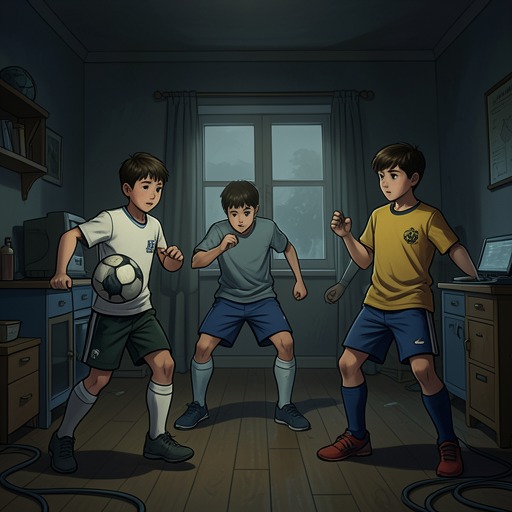
The season refuses to arrive on schedule. Winter reaches deep into April, and at least seven inches of snow and ice cover the soccer field and the city. Instead of the open field the boys expect, the narrative gives them frozen ground, severe wind, and a landscape that muffles their dreams. Kevin and Tyler stare through ice crystals at the grey sky above Wilson Street, their Christmas cleats making their feet itch while Kevin’s scratched and scuffed soccer ball rests on his lap. Their attempt to keep moving the ball indoors turns confinement into danger rather than freedom.
Alex’s punishment deepens the sense that spring break has been taken away. After his globe-kicking incident, he is grounded for twenty days with a total soccer ban, and his father prepares to throw away equipment that Alex spent more than five years saving to obtain. The next school day becomes emotionally colorless: other children happily discuss their plans, while the boys remain silent for Alex and for themselves. Even after school, they walk slowly through slush instead of rushing toward freedom, and they gather at the snow-covered soccer field before Larry’s locked stand. The holiday is no longer a future certainty; it has become a shared disappointment.
From Disappointment to Team Formation
The failed holiday nevertheless brings the boys together. Their gathering at the field becomes part of the process by which scattered players become the Wild Soccer Bunch. The group eventually gains Larry as its coach, treating him as the greatest coach in the world even though his visible work is at the lemonade stand and his professional ambitions did not reach their intended end. Spring break thus shifts from passive waiting to organized purpose: the boys must create the soccer season that weather and adults have denied them.
The same period also reveals that participation cannot be separated from family obligations. Kevin and Tyler can recover their ball only on the condition that they take Sox to practice, because their father insists that their promise to care for their dog still applies. Another boy is told to change into soccer gear, only to reveal that his brown wool sweater, checkered pants, and worn sandals are all he has. When the possibility of playing seems threatened by his clothing, spring break exposes the unequal cost of belonging to a team. The boys’ ideal of a common field survives, but it must accommodate animals, parents, missing equipment, and poverty.
Hardship, Training, and the Match
Spring break becomes a period of severe preparation rather than effortless play. The Unbeatables destroy Larry’s stand after Mickey declares it a self-service counter and the locked building prevents them from getting drinks. Their ax cuts the electrical cords, the refrigerators fail, and the lemonade turns into sticky syrup. The ruined stand and the heat leave the opposing team helpless, while the Wild Soccer Bunch continues to measure itself through practice and endurance.
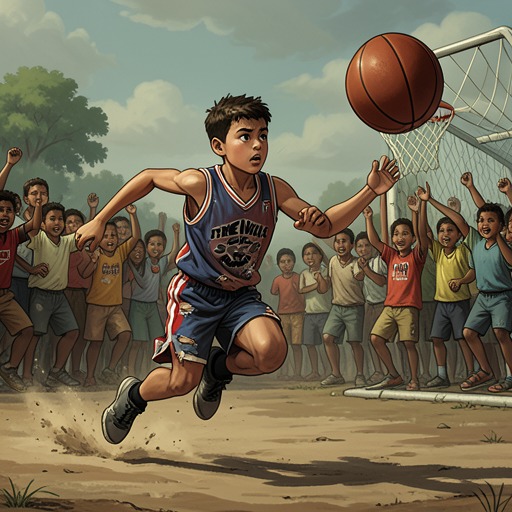
The boys’ training eventually gives the holiday a new rhythm. They practice on muddy ground for twelve days, learning to move through conditions that make the Unbeatables slide like ducks on an ice rink. The final challenge is narrated as a live sequence of passes, saves, missed chances, and changing scores. The team begins with the rallying cry, “ONE, TWO, THREE WILD!” and moves the ball through Alex, Tyler, Danny, Joey, and Kevin before Octopus stops the first attack. The Unbeatables then establish a commanding lead, but the Wild Soccer Bunch’s preparation allows the weather to become an advantage rather than merely an obstacle.
The comeback depends on collective play replacing individual impatience. Kevin scores three goals, Danny scores twice, Joey equalizes the match at seven to seven, Tyler’s long shot is carried by the wind into the goal, and Diego overcomes his asthma to become the Tornado again. When Kevin refuses to pass while chasing a tenth goal, Larry removes him and sends Roger onto the field. The decision turns spring break’s central lesson into a tactical one: the team cannot win if its strongest individual player treats victory as personal property.
The Holiday’s Lasting Meaning
The match reaches nine to nine, with the next goal deciding everything. Roger misses an earlier opportunity, while Kyle makes a decisive save by pushing Kong’s shot around the post. Roger then ignores Kevin’s instruction about which foot to use, strikes the ball, and scores the winning goal. The boys carry Roger across the field, and Kevin lies in front of the goal in disbelief as Roger becomes the hero he had never expected him to be.
Spring break therefore ends not as the carefree interval originally imagined but as the time in which the boys learn what freedom requires. Snow, soccer bans, family rules, inadequate clothing, damaged equipment, poverty, heat, mud, asthma, and fear all limit the holiday. Yet the same pressures produce mutual responsibility and a functioning team. Its decisive image is not the boys escaping every constraint, but the group transforming a ruined vacation into shared practice and a collective victory. Through that reversal, Spring break becomes the temporal frame for the Wild Soccer Bunch’s passage from frustrated children waiting for the season to players capable of making their own season together.